A truck has a built-in odometer. A trailer usually does not. But a trailer still needs tyre replacements, brake inspections, and structural checks — all at intervals that depend on the distance it has actually covered.
Tecaser solves this with a coupling system that records the truck's odometer at the moment of coupling and decoupling, and uses the difference to build a running virtual odometer for each trailer.
Record coupling and decoupling with odometer readings
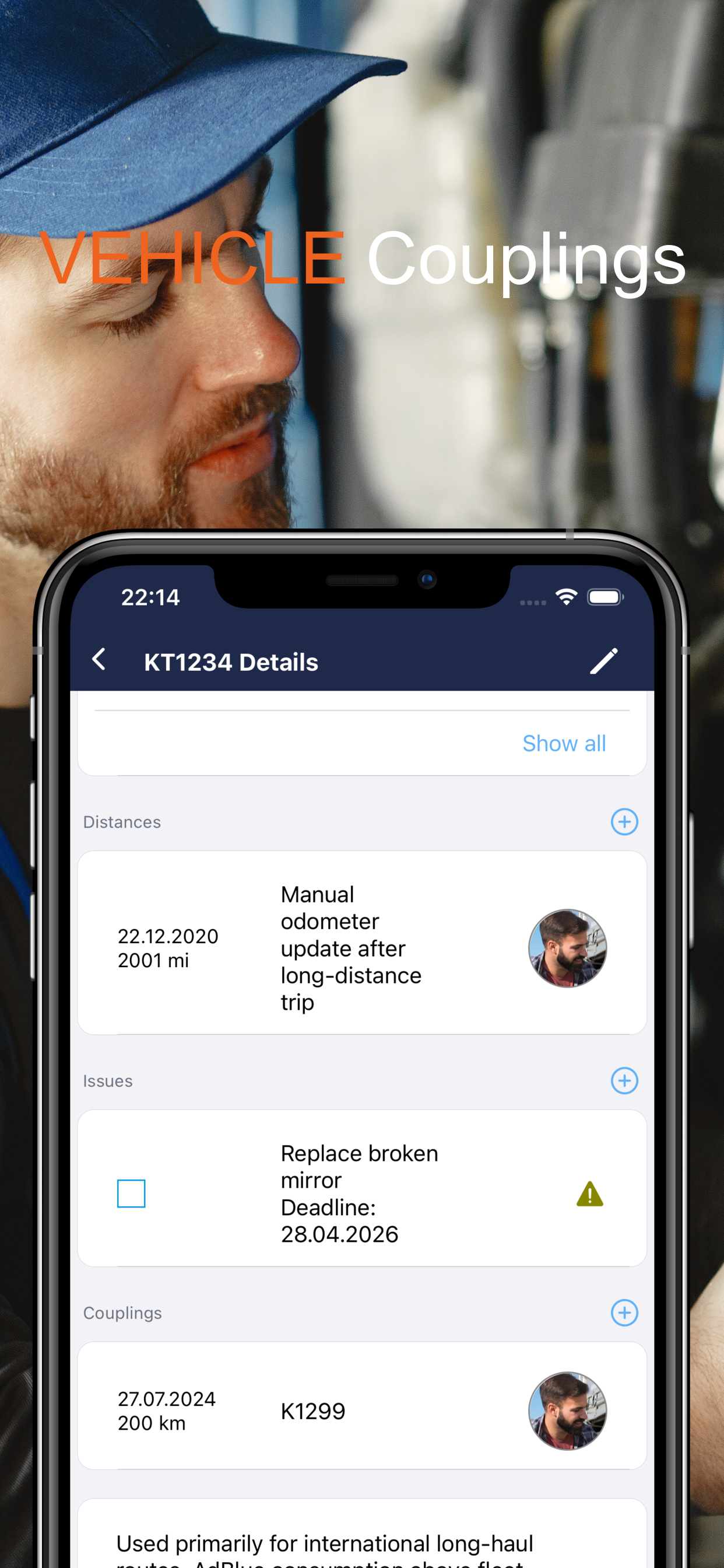
When a driver couples a truck to a trailer, they log the coupling in the app: which truck, which trailer, the date, and the odometer reading at that moment. When they decouple, they log the odometer again.
The system calculates the distance covered during that run and adds it to the trailer's accumulated total. Every coupling and decoupling creates a precise, timestamped distance record for both vehicles.
Virtual odometer for trailers without one
Most trailers have no built-in odometer. For a second-hand trailer, you may not know the exact history either. Tecaser handles both cases.
You can set an initial odometer value when adding the trailer to the system — an estimate of the distance it has already covered before you started tracking. From that point, every coupling adds to that total automatically. The result is a virtual odometer that grows with every trip, calculated from real truck data.
Trailer maintenance intervals — brake inspections, tyre changes, axle checks — are then tracked against this virtual odometer, exactly as they would be for a truck with a built-in one.
One trailer, one active coupling at a time
The system enforces a simple rule: a trailer can only be in one active coupling at a time. If a trailer is already coupled to a truck, it does not appear in the list of available trailers until it is decoupled. This prevents data entry errors and ensures every distance record is unambiguous.
Full coupling history per vehicle
Every coupling ever recorded for a vehicle is visible in its history — truck or trailer. You can see which trailer was connected to which truck, when, at what odometer reading, and for how many kilometres.
This history is part of the vehicle timeline alongside service records and issues, giving a complete picture of each vehicle's use and condition over time.
Maintenance driven by real distance
Because the trailer's virtual odometer is derived from actual truck odometer readings, the maintenance intervals configured for the trailer are triggered by real usage — not guesswork, not estimates. When a trailer reaches the configured interval for a brake inspection or tyre check, it appears in the overdue report just like any other vehicle in the fleet.
Start tracking your trailers today
Already using Tecaser? Log in and log your next coupling right now. New to Tecaser? Download the app and get started.